

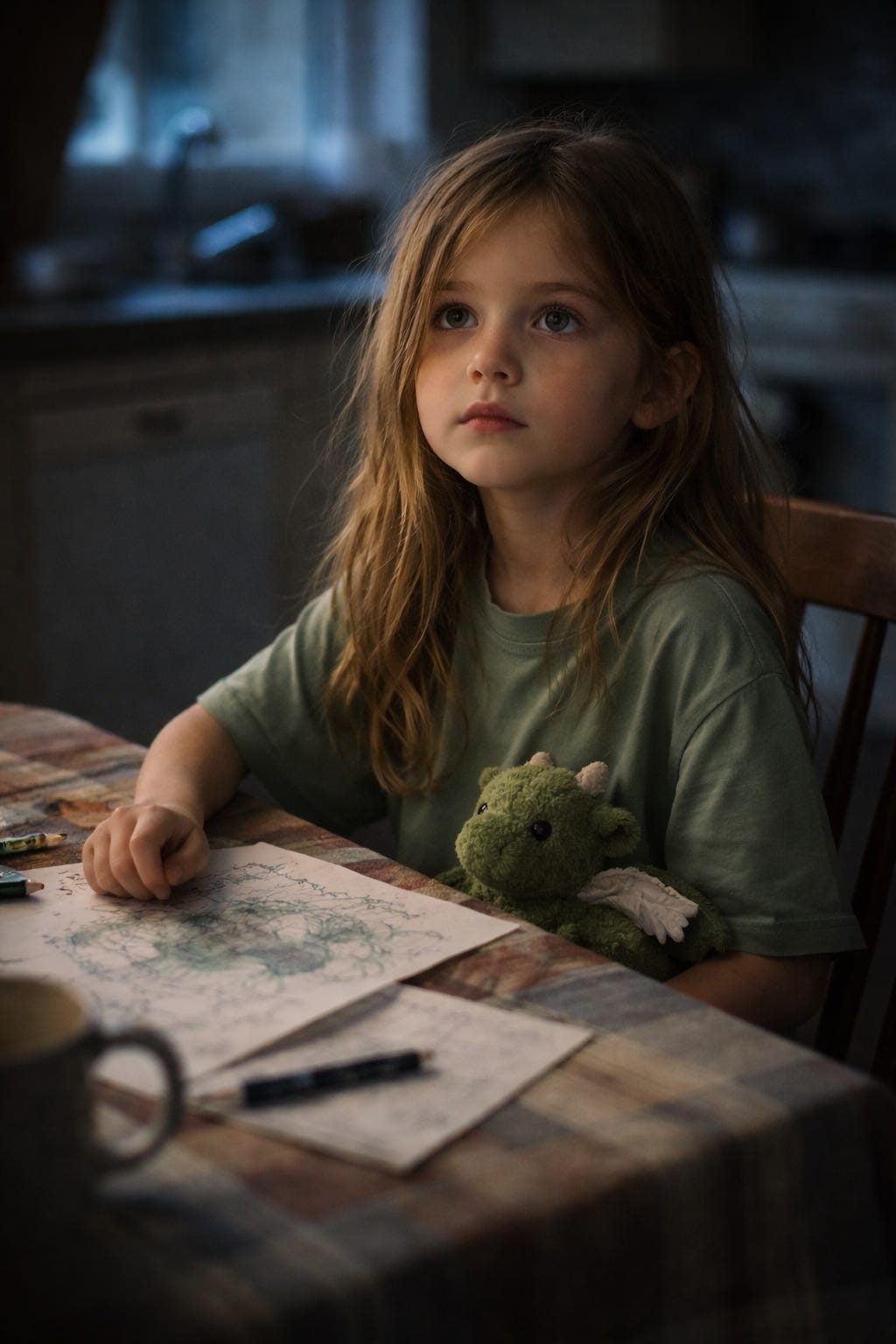
“It found us.”
The words do not sound dramatic when Ellie says them.
That is what makes them worse.
She is still sitting at the kitchen table, green marker dragging slowly across the paper. Moss rests in her lap, his bent wing caught beneath her arm. Her voice is soft. Matter-of-fact. Almost gentle.
Dan stands in the doorway and stares at her.
For a second, he thinks he must have heard her wrong.
Then the house settles around them in one long, tired creak, and the dark window over the sink reflects his own face back at him—drawn tight, pale, older than it should look this early in the morning.
“Bug,” he says carefully, “what do you mean, it found us?”
Ellie’s eyes stay on the paper.
“I don’t know.”
“You just said—”
“I know what I said.”
There is no bite in her voice. No irritation. Just a simple certainty that sits wrong in the room.
Dan steps closer to the table. The drawings are everywhere now. Not homework. Not sharks. Not jellyfish or the aquarium or anything else a seven-year-old ought to be thinking about at dawn. Spirals. Loops. Branching lines. Shapes that refuse to stay still under his eyes.
He puts a hand on the back of one of the chairs to steady himself.
“Ellie.”
She finally looks up.
And for a second something in his chest lurches, because she looks like herself and not like herself at the same time. Same sleepy hair. Same oversized pajama shirt. Same small face. But her eyes are too clear.
Too awake.
Too distant.
Then she blinks, and it is gone.
“Can I still take my permission slip today?” she asks.
The question hits him so hard in its normalcy that he almost laughs.
“What?”
“For the aquarium.” She glances down at the paper again. “You said you’d give me twenty dollars.”
He just stands there.
Then, because she is still a child and because the world has not yet fully broken open, he says, “Yeah. Yeah, I did.”
She nods, satisfied, and goes back to coloring.
Dan moves before he has quite decided to. He reaches for his phone, steps into the hallway, and calls Richard.
Richard picks up on the first ring.
That irritates Dan more than it should.
It is late afternoon when the black SUV rolls up the gravel drive.
Ellie is on the living room floor with a pencil clenched in her fist, drawing on the back of an old electric bill. She looks up at the sound of tires and brightens immediately.
“Grandpa!”
She is on her feet before Dan can stop her, running for the door. Richard barely has time to shut it behind him before she throws herself against his middle.
For one brief, ugly moment, jealousy flashes through Dan so sharply it nearly embarrasses him.
It has always been easy for her with Richard. Maybe too easy. She never saw what came before her, never lived inside the rift between the two men, never had to hold both love and blame in the same body the way Dan has since Mara disappeared into a sky that never healed right.
Richard lifts her easily, though age has put silver in his hair and fresh strain around his eyes.
“There’s my girl.”
“You came.”
“You asked me to.”
She beams and wraps her arms around his neck.
Dan watches them from the kitchen doorway with his jaw set.
Richard notices, because Richard notices everything. He sets Ellie down gently.
“Why don’t you go wash up for dinner, honey?”
“I already did.”
“Then go do it again. Humor an old man.”
She grins, rolls her eyes the way only children can without any malice in it, and disappears down the hall.
The second she is gone, the warmth leaves the room.
Richard looks at the stack of papers Dan has laid out on the table. Drawings. Pages and pages of them.
“She’s been doing this a lot?”
Dan nods once.
Richard picks up the top sheet. His face does not change, but something in his posture does—just enough tension through the shoulders to tell Dan what he already feared.
“You know what this is.”
“I know it isn’t random.”
“That isn’t an answer.”
Richard sets the page down carefully. “No, it isn’t.”
Dan laughs once, short and sharp. “You don’t get to come into my house and start talking like that. Not again.”
Richard’s eyes lift to his. “I didn’t come here to fight with you.”
“No?” Dan steps forward. “Because it sure feels familiar.”
The older man holds his ground. “If I thought there was nothing to this, I wouldn’t be here.”
“That doesn’t make me feel better.”
“It isn’t supposed to.”
The silence between them thickens.
Dan hates him for what he knows. He hates him for what he might know. He hates that after everything—after Mara, after the lies, after the half-truths and classified reports and the endless feeling that every answer came with something missing—he still had to call him.
And worst of all, part of him is relieved he came.
That part makes him feel disloyal.
Richard reaches for one of the drawings again. “She says she hears it?”
“At night. Sometimes during the day. She says it’s stronger when the house is quiet.”
Richard nods. “And she’s never heard it before now?”
“No.”
That isn’t fully true.
Dan remembers moments from months earlier, little things he brushed aside. Ellie standing under the backyard maple tree with her head tilted like she was listening to someone whisper just out of sight. Humming to herself in the car, a melody he didn’t recognize and couldn’t stop thinking about afterward. Asking him once, out of nowhere, if sound could get trapped inside people.
He had not wanted those things to mean anything.
Now he is not sure how much damage denial has already done.
Dinner is awkward in the way only family dinners can be when everyone at the table loves each other and none of them trust the silences between words.
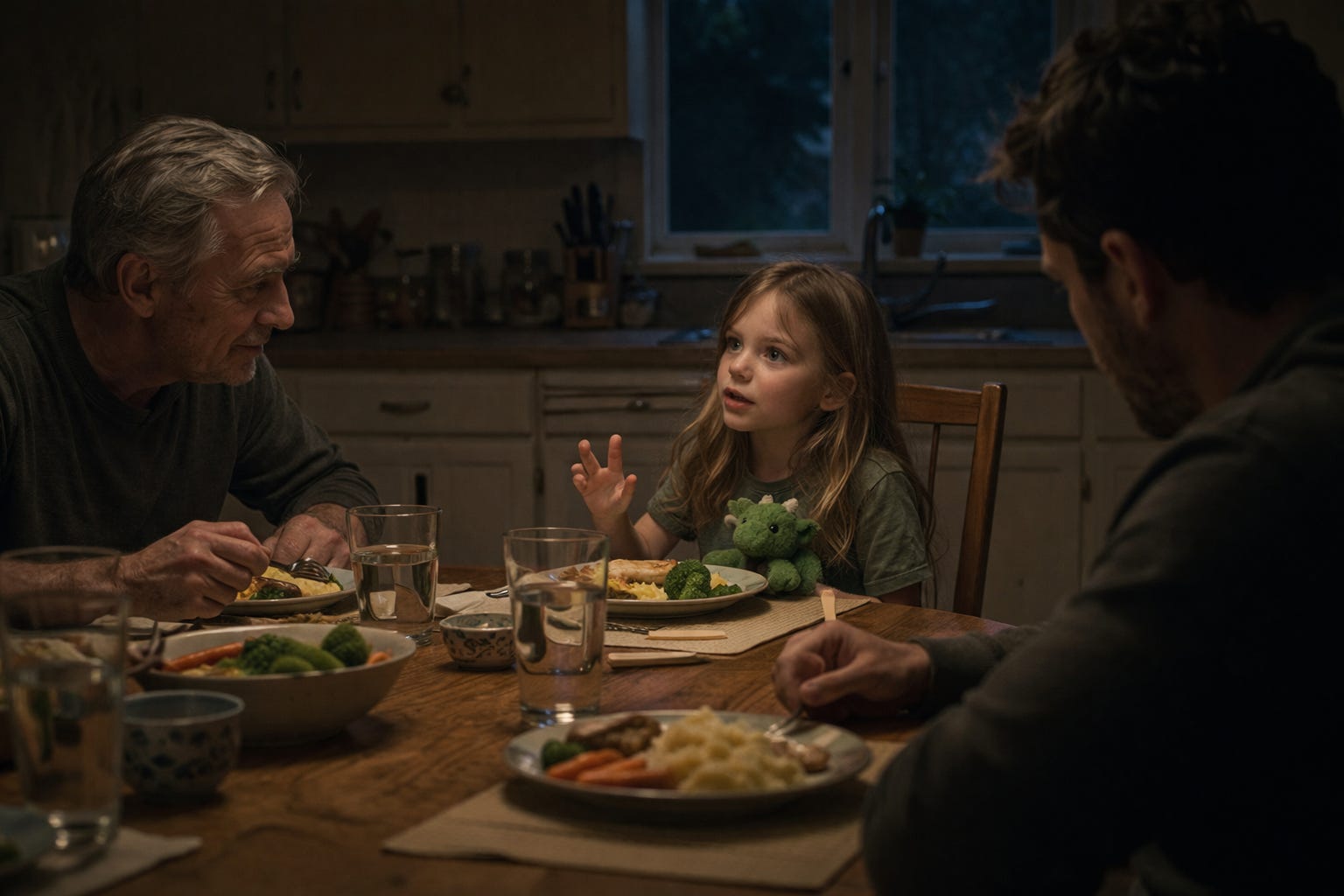
Ellie fills the space the way she always does, swinging her feet under the chair, talking around bites of food, picking up threads of conversation no one else is holding.
She talks about the aquarium field trip like it’s the most important thing in the world.
They’re going to see sharks.
Not just regular ones—ones that have to keep swimming or they’ll stop breathing.
She says that like it’s a secret.
Like it matters.
She asks if sea turtles can remember things the way people do, if they know where they’ve been or if they just follow something inside them.
She talks about jellyfish next—how they don’t have brains, how they glow, how some of them are older than trees.
Richard listens to her like he always has—patient, attentive, answering every question like it deserves to be answered.
Dan watches her.
Watches the way she dips her bread into her plate, the way she pauses mid-sentence to reach down and adjust Moss in her lap, tucking him closer like she doesn’t even realize she’s doing it.
There’s a popsicle stick on the table beside her plate.
He hadn’t seen her bring it in.
He doesn’t ask.
At some point she starts telling the same story twice.
Word for word.
She doesn’t notice.
Neither of them says anything.
Halfway through the meal, Ellie goes quiet.
It happens slowly enough that Dan notices it before anyone else. Her fork stills halfway to her mouth. Her eyes drift past his shoulder toward the dark window over the sink.
“Ellie?”
She does not answer.
Richard sets his fork down.
“Ellie, look at me.”
She blinks once, then turns her head toward them, expression distant and too calm.
“It’s closer,” she says.
Dan’s chair scrapes violently across the floor as he stands. “What is?”
Her gaze slides back to the window.
“The humming.”
No one speaks.
Because the awful thing, the thing Dan will never admit aloud, is that he hears it too.
Low. Steady. There beneath the tick of the kitchen clock and the hum of the overhead light.
A vibration with no source.
Richard rises slowly. “Get away from the windows.”
Dan does not even think before moving to Ellie’s side. “Come here.”
But she does not get up. She looks out into the dark yard, toward the line of trees beyond the fence, and whispers, almost wonderingly,
“It found us.”
He gets her to bed because there is nothing else to do.
Moss is clutched so tightly beneath her arm that one of his seams looks in danger of splitting. She lets Dan tuck the blanket around her without complaint. She does not ask for a story. She does not ask for a popsicle. She only says, very quietly, “Don’t go far.”
“I won’t,” he promises.
Her eyes stay on him until he shuts the door almost all the way.
Richard waits in the kitchen.
Too still. Too quiet. Like he has been expecting something Dan has not yet found words for.
Outside, the dark presses against the windows.
Inside, the house feels smaller than it should.
The equipment outside is failing.
Lights stutter through the windows in uneven pulses, throwing the room in and out of shadow. The hum is no longer something you listen for—it’s inside everything now. Low. Constant. Pressing into bone.
Dan can feel it in his teeth.
Richard stands at the table, one hand braced against it like the ground might give out if he lets go. He has not looked at Dan in too long.
Dan watches him.
Knows.
“Say it.”
Richard exhales slowly, like he has been holding it in for years.
“There are things you don’t understand about what’s happening.”
Dan lets out a sharp, humorless breath. “Then start explaining.”
“It isn’t that simple.”
“Try me.”
The light flickers again. The hum deepens, just slightly.
Richard finally looks at him.
And there is no authority left in it now. No distance. Just something tired. Worn thin.
“I didn’t tell her everything.”
Dan doesn’t move.
“…What?”
“Mara,” Richard says. “Before the mission.”
Dan’s jaw tightens. “What didn’t you tell her?”
Richard hesitates—just a second.
That is all it takes.
Dan steps forward. “No. Don’t do that. Don’t think about it. Say it.”
Richard’s voice lowers. “We had data. Early readings from the anomaly. It wasn’t behaving like anything we understood. It responded to observation. It changed—”
“That doesn’t mean anything.”
“It meant enough.”
Dan shakes his head. “Enough for what?”
Richard doesn’t answer.
Dan’s voice sharpens. “Enough for what?”
The hum presses harder.
Richard’s grip tightens on the chair.
“Enough to suggest it wasn’t passive.”
Dan lets out a short, disbelieving laugh. “Passive. You keep saying that like I know what the hell it means.”
Richard meets his eyes.
“It interacted with biological systems.”
The room goes still.
Dan stares at him.
Then, quieter—
“You sent her anyway.”
“I sent the most qualified person—”
“You sent your daughter.”
“I sent the only person who could understand it before it escalated.”
Dan’s voice rises. “Before it what? It was in orbit!”
“It wasn’t staying there.”
That lands wrong.
Dan’s breath catches. “You knew that.”
Richard doesn’t answer.
And that silence is everything.
Dan drags a hand through his hair, pacing once, fast.
“What happened up there?”
“There was a contact event.”
Dan turns back sharply. “Define contact.”
“It responded directly to her.”
“How?”
“I don’t know.”
“That’s not an answer!”
“It’s the only one I have!”
The words crack out of Richard louder than anything he has said so far.
They both freeze for a second.
The hum pulses.
Dan’s voice drops, shaking now. “What did it do to her?”
Richard swallows.
“It didn’t attack.”
“Then what did it do?”
A beat.
“It synchronized.”
Dan stares at him like he did not hear right.
“That’s not a real answer. Try again.”
“It aligned with her neural activity. Her biological rhythms. It adapted to her.”
Dan shakes his head harder, backing up a step. “No. No, that’s not—people don’t just sync with something like that.”
“We didn’t think so either.”
“But you had data.”
“Yes.”
“And you didn’t tell her.”
A beat.
“No.”
Dan laughs—but it breaks halfway through.
“She came back,” he says.
“Yes.”
“And you cleared her.”
“There was nothing conclusive—”
“She was different.”
Richard doesn’t argue.
Dan steps closer again, anger bleeding through now, raw and unfiltered.
“She couldn’t sleep. She kept hearing things. She said—” His voice falters. “She said it felt like something was trying to understand how to exist here.”
Richard closes his eyes.
“Yes.”
Dan’s breath stutters. “You knew.”
“I suspected.”
“You knew.”
“I didn’t know what it would become!”
“But you knew it did something!”
“Yes!”
The word hits the walls and doesn’t come back.
Dan turns away, pacing harder now, faster.
“You just let her live with it? Let us live with it?”
“I monitored—”
Dan spins. “You monitored it?”
“It wasn’t spreading!”
Dan’s voice cracks. “It didn’t have to!”
Silence.
The hum fills it.
And then—
Dan stops moving.
Slowly.
Like something just fell into place.
“…Ellie.”
Richard looks at him.
That is it.
That is all it takes.
Dan steps back like he has been hit.
“No.”
“She was young—”
“No.”
“Close exposure—”
“No.”
“Her system adapted—”
“No!”
Dan’s voice breaks completely now.
“That’s my daughter.”
Richard’s voice tightens. “She’s the only one who can survive what’s happening out there.”
“I didn’t ask what she can survive!”
The lights flicker violently. The hum spikes—sharp, wrong—and both men flinch.
Dan’s breathing is uneven now.
“You’re telling me… this—” he gestures wildly toward the windows, the sky, the wrongness pressing in “—this is because of you.”
Richard doesn’t answer.
Because he can’t.
Dan laughs again, hollow and shaking.
“You sent her up there without telling her the truth.”
“I made the best decision I could with the information I had—”
“You made a decision for everyone!”
“I made a decision to protect this world!”
“At what cost?!”
Richard doesn’t answer fast enough.
Dan steps forward, close now, too close.
“At what cost?!”
Richard’s voice breaks.
“I didn’t know it would—”
“You didn’t know?” Dan lets out a harsh, broken sound. “You didn’t know?! You had data, you had warnings, and you still sent her!”
“I didn’t think it would follow her back!”
“You didn’t think?!” Dan shoves the chair out of the way, it crashes hard against the wall. “You don’t get to not think! You don’t get to gamble with people like that!”
“I was trying to understand it!”
“You were trying to control it!”
Richard flinches.
Because that one lands.
From down the hall—
a small sound.
Ellie shifting in bed.
Both men go still.
Dan’s voice drops to something wrecked.
“…You did this.”
Richard looks at him.
And for the first time—
there’s nothing left to hide behind.
No authority.
No justification.
No control.
Just a man who got it wrong.
“I didn’t mean to.”
The words are quiet.
Almost lost under the hum.
But they land harder than anything else.
Dan stares at him.
And whatever was holding him together—
gives.
“Get out.”
Richard doesn’t move.
Dan’s voice rises, sharper, breaking.
“Get out!”
“I—”
“GET OUT!”
The word tears out of him, raw and violent.
Richard flinches like he has been struck.
He looks toward the hall once—toward Ellie’s room.
Then back at Dan.
There is something like regret in his face.
Something like apology.
But it is too late for that.
He nods once.
Small.
Broken.
And he leaves.
The door opens.
The hum rushes in louder for a second—
then dulls again when it shuts.
Dan stands there, breathing hard, staring at nothing.
The house feels too big.
Too quiet.
Too wrong.
From down the hall—
Ellie.
Soft.
“…Dad?”
He is moving before she says anything else, down the hall and into her room with the taste of copper in his mouth and the echo of Richard’s voice still beating against the inside of his skull.
Ellie is sitting up in bed.
Moss is clutched tightly against her chest, one hand fisted so hard in the blanket her knuckles have gone white. Her eyes are huge in the dim light.
Wet.
He drops to the edge of the bed so fast it jars the mattress.
“Hey. Hey, Bug, I’m here.”
She reaches for him before he is finished speaking.
He gathers her into his arms and she folds against him so quickly, so desperately, that his heart feels like it might split under the force of it.
“It’s loud,” she whispers.
“I know.”
He smooths a trembling hand over her hair.
Outside, something flashes across the wall. Not lightning. Too slow. Too deliberate.
Ellie presses her face into his shoulder.
“Dad…”
“I’ve got you.”
She shakes her head against him. “I don’t want it.”
His throat closes around the answer.
“I know, Bug.”
He means the humming. The fear. The thing in the walls and the thing in the sky and the thing Richard has just told him without ever truly saying it cleanly.
For a while neither of them moves.
Then, slowly, Ellie’s breathing evens out.
Not because she is calm. Just because children are cruelly made to tire even when they are afraid.
Dan stays there until he is sure she is asleep.
He does not go back to bed.
The next morning, the sky changes.
It begins as a shimmer on the horizon, a strange brightness bleeding through morning cloud cover where no sun should be. By noon, half the county is outside staring upward. By evening, the whole world is.
Now all of it seems to gather itself at once.
The aurora stretches from edge to edge of the sky, colors too vivid and too wrong, moving with a deliberate grace that strips the word weather of all meaning. It ripples and folds and gathers itself like thought made visible.
People cry on the news.
Scientists stammer through explanations no one believes.
Military vehicles pass in convoys down roads that have only ever known tractors and school buses.
By sunset, Richard has half the yard turned into a temporary command post.
Dan wants all of them gone.
Instead, he has armed men pacing the perimeter fence and technicians unloading equipment that looks improvised and inadequate all at once.
Richard is back now not only as grandfather, not only as the man who broke his daughter and then told him so, but as command. As authority. As the face of the same machine that has been swallowing pieces of their lives for years and calling it necessity.
Ellie stands on the back porch, staring up at the aurora as though she has been waiting for it.
Dan crouches in front of her and takes her face between his hands. “Talk to me.”
She looks at him, and her eyes are clear, far too clear.
“It’s here.”
His throat tightens. “What is?”
She glances toward the sky. “What Mom ran from.”
The words hit him hard enough that for a second he forgets how to breathe.
Richard, standing a few feet behind them, goes still.
“Ellie,” Dan says carefully, “what do you mean?”
She swallows. “It’s what broke them apart.”
“Who?”
Her mouth trembles. “Everything.”
Dan hasn’t slept through the night.
Not since the sky changed.
Not since the reports started—power fluctuations, blackouts, strange lights on the horizon, birds flying in the wrong direction like something deep in the world has shifted just slightly off its axis.
The field forms the next day at the edge of the tree line.
One moment there is only heat haze over the grass.
The next, the air bends inward on itself, light distorting around a patch of earth no bigger than a swimming pool. Nothing dramatic marks its birth. No lightning strike. No explosion. Just reality quietly admitting it has torn.
The closer people get, the stranger it feels.
Sound delays. Shadows pull in the wrong direction. The hum deepens until it no longer feels like sound at all, but pressure.
The military tries barriers first. Then drones. Then machines designed to measure and neutralize phenomena they do not understand.
Nothing works.
Nothing holds.
The field does not widen, but everything around it begins to strain, like the world is being pulled toward a point it cannot survive.
And through all of it, Ellie draws.
She draws spirals that look almost like storm systems until you notice the geometry beneath them. She draws branching lines that repeat in the neural maps technicians are suddenly finding in altered bloodwork. She draws circles within circles, broken and reconnecting, over and over until the paper tears beneath her pencil.
Dan finds her crying over one of the drawings that night.
Not loud. Not messy. Just tears slipping silently down her face while she stares at a page she does not seem to remember making.
“Baby?”
She shakes her head.
He kneels beside her bed. “What’s wrong?”
“I don’t want to.”
His stomach drops. “Don’t want to what?”
She presses both palms hard against her temples. “They’re hurting.”
He reaches for her. “Who’s hurting?”
Her voice comes apart on the word. “Them.”
She drags in a shaky breath. “They can’t stay together. It’s pulling them apart and I can feel it and I don’t know how to make it stop.”
He holds her because there is nothing else to do. Holds her while she cries against his chest and says things no child should know, words that do not make sense until suddenly they do.
It is the next morning when she says it.
The field has started pulling power from the command units. The air near the tree line flickers with fractures of light. Every screen in the house is dead.
Dan turns when he hears her voice behind him.
“It’s already in me.”
He stares at her. “What?”
She is pale. Shaking. Still small enough that her sweatshirt sleeves cover half her hands.
“It’s already in me,” she whispers again. “I was around Mom the most. I heard it first. It changed me first.”
Richard closes his eyes.
Dan turns on him so fast it almost feels like violence. “What does that mean?”
Richard does not answer quickly enough.
“Richard.”
The older man looks at Ellie, not Dan. His face seems older than it did yesterday.
“It means,” he says carefully, “her exposure wasn’t the same as ours.”
Dan’s voice goes hoarse. “Speak plainly.”
Richard does.
“Whatever Mara carried, whatever bonded to her, whatever survived contact with her body, Ellie was exposed to it longer and earlier than anyone else. Close contact. Repeated contact. Developmental vulnerability.” His jaw tightens. “If it’s rewriting anything, it would start with the person whose system was still forming.”
Dan stares at him.
No.
No.
No.
But even as the denial rises, something inside him is already crumbling, because he knows. He knows in the way a body knows before a mind can bear it.
Ellie nods once through her tears, as if Richard has only said aloud what she has already begun to understand.
“It recognizes me.”